
Exploring Utopia by Design: A Journey Through the London Design Biennale 2016 at Somerset House
In September 2016, London welcomed its first-ever Design Biennale, an ambitious and thought-provoking event held within the grand neoclassical architecture of Somerset House. We had the privilege of visiting this groundbreaking exhibition, which brought together 37 countries, each contributing unique perspectives to the overarching theme of ‘Utopia by Design’. This inaugural Biennale was strategically timed to coincide with the 500th anniversary of Thomas More’s seminal work, ‘Utopia’ – a fictional and philosophical masterpiece that has shaped discourse on ideal societies for centuries. The event sought to reimagine these timeless utopian ideals through a global lens, showcasing contemporary design ideas and outcomes that bravely confronted pressing global issues such as sustainability, migration, pollution, energy consumption, urban development, and social equality.
What truly set this Biennale apart was its refreshing departure from the conventional, commercially driven ‘show and tell’ events. Instead, it offered a vibrant platform for truly engaging and conceptual thinking, drawing from an unparalleled array of global design perspectives. Designers, by their very nature, are often at the vanguard of envisioning and facilitating new ideas for improved living, driven by a profound awareness and understanding of our collective future needs and aspirations. In an era characterized by exponential technological advancement, volatile political landscapes, and an ongoing quest for optimal ways of living and being, the question, “What is utopia?” resonates with as much urgency and relevance today as it undoubtedly did in 1516 when More first penned his ideas.
The installations and prototypes on display invited visitors to ponder not just aesthetic beauty but also profound philosophical questions, challenging preconceived notions of perfection and possibility. It was an inspiring experience, offering a glimpse into how creative minds worldwide are harnessing design as a powerful tool to address complex challenges and shape a more harmonious future. We found ourselves immersed in a world where innovative solutions met artistic expression, and where every corner of Somerset House seemed to whisper tales of envisioned futures. Below, we share our twelve most memorable and inspiring utopian visions from the London Design Biennale 2016.
Most Dreamy: Austria’s ‘LeveL’
Austria’s contribution, ‘LeveL’, captivated visitors with its ethereal beauty and subtle kinetic interaction. This delicate installation comprised numerous hand-sewn paper lampshades, each mounted on the end of perfectly balanced rods. The genius of ‘LeveL’ lay in its ability to embody a fragile utopian equilibrium: when the exhibition space remained perfectly still, the entire installation glowed at full brightness, creating an atmosphere of serene perfection. However, the moment human presence or interference disturbed this delicate balance, individual lights would subtly dim, a gentle yet profound visual representation of how easily utopia can be unsettled. This piece served as a poignant metaphor for the environmental and social systems we inhabit, reminding us of the interconnectedness of our actions and the impact they have on the harmony of our shared spaces, both physical and conceptual.
Most Illuminating: Russia’s ‘Utopia, Lost Archives of Soviet Design’
Russia’s ‘Utopia, Lost Archives of Soviet Design’ offered a truly impressive and historically significant look into the ambitious industrial design landscape of the Soviet Union from the 1960s to the 1980s. This extraordinary collection, much like countless other forgotten industrial archives, was almost lost to time before its recent rediscovery. For the Biennale, hundreds of these original 35mm slides were meticulously scaled up and backlit, transforming them into a vast, glowing display of ingenious projects. These ranged from large-scale infrastructural concepts to everyday consumer goods, all envisioned by eminent Soviet thinkers and design practitioners. The exhibition not only served as a powerful testament to the utopian aspirations of the Soviet era – a belief in design’s capacity to shape a perfect society – but also highlighted the fascinating intersection of ideology, innovation, and forgotten history. It was a rare opportunity to witness a bygone era’s dreams of progress and societal betterment through design.
Most Theatrical: Taiwan’s ‘Eatopia’
Taiwan’s ‘Eatopia’ was an absolute delight for all senses, transforming the nation’s rich history and vibrant culture into a captivating culinary performance. Guests, including ourselves, were invited into a magical, immersive forest setting, where a long white dining table, shaped like the upturned island of Taiwan, awaited. Here, we sampled five specially conceived and meticulously prepared Taiwanese food concepts, each dish representing a pivotal stage in the country’s dynamic and ever-evolving history. The experience was a beautiful blend of storytelling, gastronomy, and artistic design, where food became a medium to explore national identity and aspirations. The grand finale, a dish aptly named ‘The Melting Pot’, perfectly encapsulated a truly utopian outlook: embracing cultural change and diversity for the collective good of all. ‘Eatopia’ beautifully demonstrated how design can extend beyond objects to create immersive, experiential narratives that resonate deeply with participants.
Most Humanitarian: Israel’s ‘Human.Touch’
Israel’s ‘Human.Touch’ profoundly illustrated that the spirit of caring and social responsibility remains a powerful driving force in contemporary design. Their exhibit featured two groundbreaking designs, each aimed at positively impacting vulnerable communities. The first was an innovative speaker system that ingeniously translates auditory input into perceptible floor vibrations and rich visual textures, offering a new dimension of experience for the deaf or hard of hearing. This thoughtful design highlights how technology can bridge sensory gaps and foster inclusion. The second design, ‘AIDrop’, was an affordable, oversized cardboard seed pod, reminiscent of a sycamore, specifically engineered to contain vital disaster relief kits. These pods could be dropped en masse into areas of urgent need, providing immediate assistance to those affected by humanitarian crises. Both inventions showcased pure genius in their simplicity, practicality, and profound potential to enhance human well-being and save lives, embodying a truly humanitarian vision of utopia.
Most Psychedelic: India’s ‘Chakraview’
Stepping into India’s ‘Chakraview’ was like being instantly transported to another dimension. The experience began with a super-saturated, mirror-tastic entrance that playfully disoriented and delighted visitors, setting the stage for the vibrant journey ahead. This led into an ultra-vivid, glowing blue cinema space, where a compelling narrative unfolded. The film charted India’s truly inspiring fusion of ancient philosophy and profound wisdom, demonstrating how these enduring principles are translated into pragmatic and resourceful design solutions for the benefit of the entire nation. The installation was a dazzling, colourful culture-shock, executed with the captivating brilliance that India is renowned for. It not only showcased the country’s rich heritage and innovative spirit but also succeeded in momentarily transporting visitors to a completely different realm of thought and perception, blurring the lines between the practical and the mystical in a truly utopian fusion.
Most Beautiful: Tunisia’s ‘Pulse Diagram’
Tunisia’s ‘Pulse Diagram’ was an installation of profound beauty and poignant symbolism. It celebrated the concept of a feasible utopia, one built not on grand, unyielding structures but on the fragile yet resilient foundations of 54 interconnected charred timber posts. These posts, standing in delicate equilibrium, in turn supported an intricate web of threads. This web was not merely decorative; it was a carefully constructed metaphor, suggesting the complex nodes and multifaceted inter-relationships between the 54 cities envisioned in Thomas More’s original Utopia. The charred timber added a layer of history and vulnerability, implying that even ideal societies carry the marks of past challenges and require constant care. We were utterly transfixed by the overall effect – a visually stunning and intellectually stimulating piece that conveyed the delicate balance and intricate dependencies inherent in any pursuit of an ideal collective existence.
Most Poetic: Japan’s ‘A Journey Around the Neighbourhood Globe’
Japan, represented by designer Yasuhiro Suzuki, curated a world steeped in fascination and poetic beauty with his exhibit, ‘A Journey Around the Neighbourhood Globe’. This space felt like a beautifully curated room filled with contemporary curiosities, each object offering a glimpse into alternative realities through the most exquisite thinking and meticulous craftsmanship. We willingly lost ourselves in this captivating space, spending a considerable amount of time marveling at the intricate details and conceptual depth of each piece. Choosing a single favorite object proved to be an almost impossible task due to the sheer abundance of captivating designs. However, one item that particularly resonated was an acrylic suitcase containing miniature, magnetized islands of Japan and the UK. These tiny landmasses floated gracefully on the surface of a glass of water, acting as delicate, symbolic compasses, gently pointing towards a potential future path of interconnectedness and shared direction. It was a profound illustration of how design can inspire introspection and global harmony.
Most Retro: Chile’s ‘Counterculture room’
Stepping into Chile’s retro-utopian ‘Counterculture room’ was an immediate and immersive experience, akin to walking onto a set from a 1970s science fiction film. The room was furnished with iconic white plastic chairs, adorned with the obligatory bright orange cushions, facing screens displaying endless streams of unfathomable data. This aesthetic, while evoking smiles, belonged to a serious 1971 government experiment known as Project Cybersyn. This ambitious project aimed to implement a system of cybernetic management and real-time information flow to promote holistic design, decentralized management, and seamless human-computer interaction across the nation. The use of this distinct retro design aesthetic served as a powerful reminder of earlier utopian thinking. It prompted a fascinating contemplation: while these ideas were often considered hip and cool in their time, they can, with the passage of years, sometimes mutate into representations of seemingly silly or naive concepts. Yet, the exhibition left us pondering, could there still be valuable lessons or overlooked foresight within these ambitious past visions?
Most Satisfying: Germany’s Tranquil Spaces
Germany’s exhibition offered a dual experience focused on profound thoughtfulness and serene tranquility, providing a welcome respite amidst the Biennale’s vibrant energy. The first room, intensely white and brightly lit, featured the engaging text ‘Utopia means Elsewhere’ by John Malkovich, elegantly framed large on an easel. This powerful textual piece invited visitors to recalibrate their minds with the beautiful simplicity of words after absorbing a multitude of design-based offerings. Transitioning into the second room was a complete shift: it was entirely dark, save for the inviting glow of four easy chairs. These chairs beckoned visitors to kick back and lose themselves in a mesmerizing digital LED fire, meticulously designed to replicate the hypnotic flicker of real flames. The experience was further enhanced by authentic roaring, snapping, crackling, and popping sounds, complemented by an ambient aroma of burnt wood. We ended up spending a good twenty minutes in this comforting space, thoroughly chilling out and enjoying a moment of perfect, sensory-rich relaxation, a truly satisfying utopian escape.
Most Monumental: The UK’s ‘Forecast’ by Barber and Osgerby
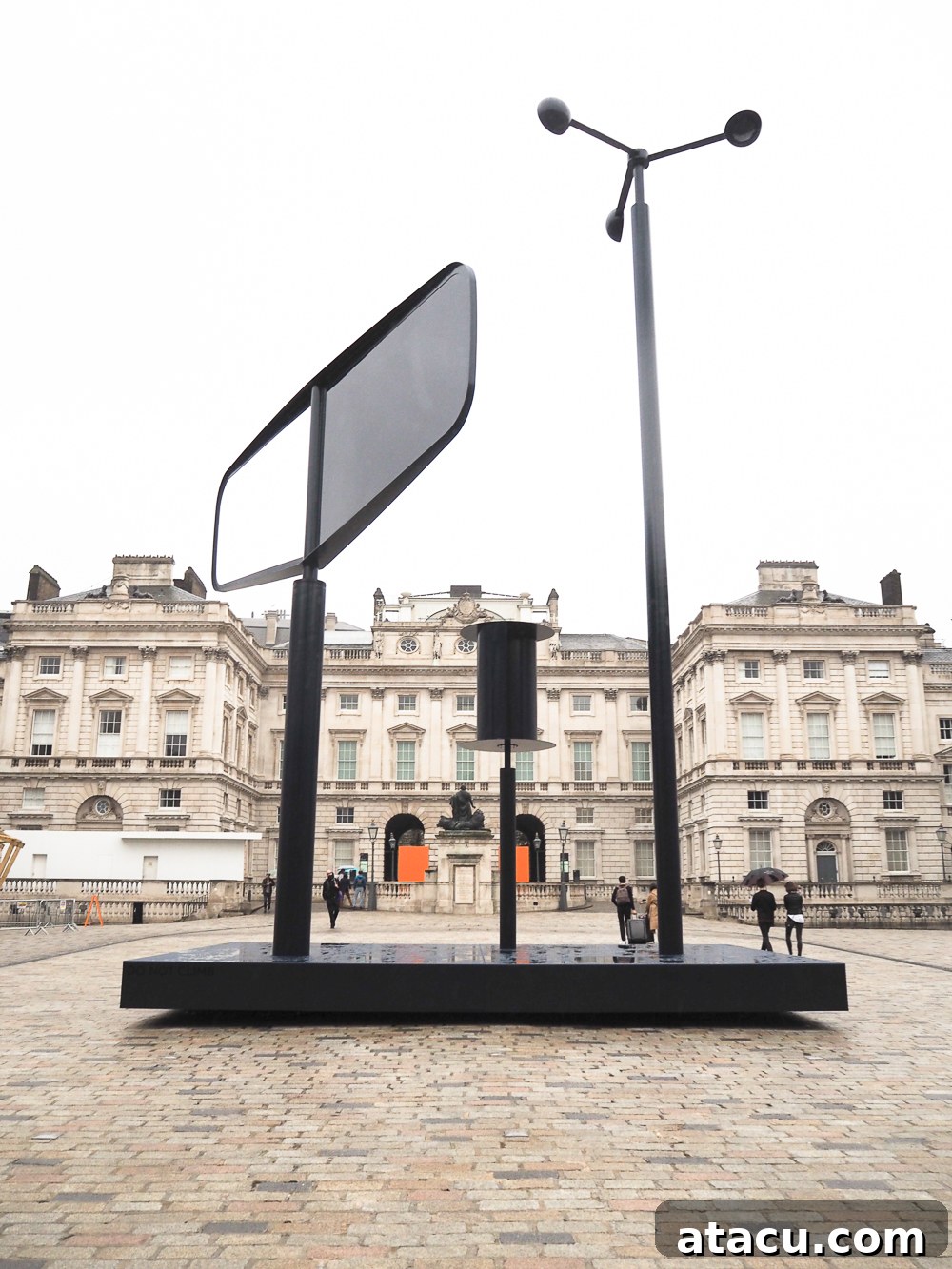
Taking center stage in Somerset House’s grand courtyard was the UK’s monumental contribution, ‘Forecast’, conceived by the renowned design duo Barber and Osgerby. This striking installation comprised three large-scale, wind-dependent sculptures, each a powerful visual metaphor. They deftly referenced the nation’s enduring obsession with its ever-changing weather, a phenomenon both literal and metaphorical in British culture. Beyond this, the sculptures paid homage to the UK’s historical dependency on wind, particularly from a maritime perspective, highlighting its pivotal role in the country’s past. Crucially, they also cast an eye towards a sustainable future, driven by renewable energy. On the day of our visit, the weather was characteristically calm and wet, ensuring the sculptures remained relatively subdued in their movements. Nevertheless, their imposing presence and profound conceptual layers made ‘Forecast’ an unmissable and deeply resonant representation of a future shaped by environmental consciousness and national heritage.
Most Thought Provoking: Mexico’s ‘Border City’
Mexico’s ‘Border City’ offered perhaps the most timely and thought-provoking utopian vision, presenting a bi-national city masterplan conceived for the border between Mexico and the USA. This ambitious concept was brought to life through a seamless digital audio-visual wrap-around experience, projected onto curved walls and complemented by a large central model. The installation meticulously imagined a symbiotic relationship between two differing cultures, where mutual respect and shared benefits transcend political divides. Animated charts, insightful infographics, and beautifully rendered ‘lifestyle’ clips showcased how both sides could trade cultural and economic advantages for the greater good. This exhibit was exceptionally topical, especially at a time when many countries worldwide were retreating towards nationalism and various forms of ‘self-protectionism’. ‘Border City’ served as a powerful counter-narrative, proposing that true progress and harmonious living might lie in embracing integration and mutual understanding rather than isolation.
Most Everyday: Lebanon’s Outdoor Street Scene
Our final stop on this utopian tour of the world was Lebanon’s outdoor street scene, beautifully recreated on the river terrace of Somerset House. It felt less like an exhibit and more like an authentic transportation to a place of ‘non-design’ – or, perhaps more accurately, a perfect snapshot of Middle-Eastern everydayness. This installation exuded personality through the unending resourcefulness and vibrant spirit of a happy and contented people, characterized by their ingenious, make-shift approach to life. The welcoming atmosphere was palpable, and we happily accepted their friendly invitation to sit down amidst the recreated streetscape. There, we enjoyed a truly delicious falafel pita, freshly prepared and bursting with a tasty Lebanese salad, generously drizzled with tahini sauce. It was a perfect, grounding end to our journey, reminding us that utopia isn’t always about grand schemes or technological marvels, but often found in the simple, authentic joy and resourceful harmony of everyday life and human connection.
Despite the persistent rainy weather that accompanied our visit, we left Somerset House feeling utterly satisfied. Our minds were buzzing with a multitude of interesting concepts, groundbreaking ideas, and, of course, the lingering taste of some seriously good food. The London Design Biennale 2016 truly succeeded in presenting a global dialogue on what utopia could mean for the future, inspiring us to look at the world through a new, more hopeful, and design-conscious lens.
* * *
The London Design Biennale was exhibited at Somerset House until September 27th, 2016. More information can be found here.
Words by Graham Powell and photography by Helen Powell for Design Hunter.